Generating code vs. Designing a system: the key role of the architect in the age of AI
Author Caleb AdjeodaDate Sep 1, 2026Read 4 Min
"AI writes the lines, but it’s the architect who writes the story."
We live in fascinating times. With the advent of GitHub Copilot, ChatGPT and Claude, the barrier to entry for "creating a website" or "writing a function" has never been lower.
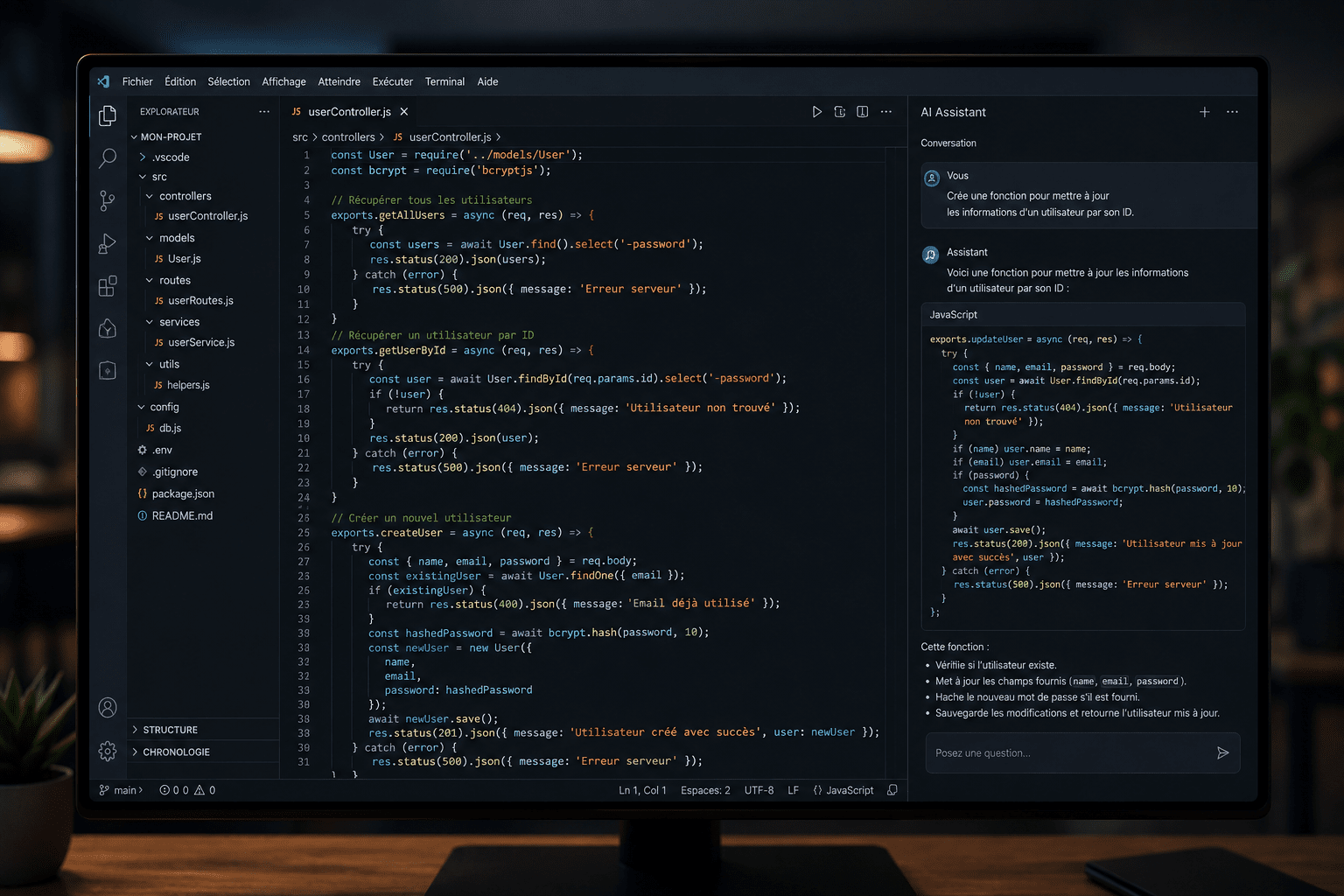
As developers, we are overwhelmed with tools that can generate thousands of lines of code in seconds.
In the face of this revolution, a legitimate question emerges: Will artificial intelligence replace software engineers?
The short answer is no (this is my opinion). But the long answer is much more subtle and exciting. The AI era does not mark the end of the developer; it marks the beginning of the golden age of the Software Architect.
1. The Code Generation Trap
It is undeniable that AI excels at code generation. It is perfect for:
The boilerplate: Create basic REST CRUD APIs.
Snippets: Write a simple sort function or SQL query.
La traduction: Convertir du code Python en JavaScript.
Unit tests: Generate base cases for your components.
The illusion is that productivity increases linearly. We say to ourselves: "If the AI writes the code, I only need 2 developers instead of 10."
It’s a dangerous illusion.
AI generates code, but it doesn’t understand the business context, it doesn’t understand network constraints, and it completely ignores long-term technical debt. It is statistical, not semantic.
Building an information system is not about stacking libraries. It’s about making enlightened compromises.
Here is what an AI cannot do (at least not yet):
Choose the right database: SQL vs NoSQL? Should I use PostgreSQL, MongoDB, or Redis in cache? An AI doesn’t know your data volume or access patterns.
Manage Scalability: How do I sharpen my database when I reach 1 million users? How to manage eventual consistency?
Define bounded contexts (DDD): Where does the "Payment" domain end and the "Delivery" domain begin? This demarcation is purely human and professional.
Security and Zero Trust: AI can write JWT middleware, but it doesn’t design a Zero Trust security policy for your organization.
Technical debt and maintainability: A generated code is often rigid. The architect thinks in terms of Design Patterns and SOLID principles so that the code remains livable in 5 years.
This is where tools that are sometimes considered "obsolete" intervene, such as UML and Merise. Far from being obsolete, it is the universal languages that make it possible to model complexity before the code is written.
3. Why do my skills in Mathematics and Theory count twice
As an engineer trained in mathematics and theoretical computer science, I see software architecture as an optimization problem.
Algorithmic complexity (Big-O): It’s not just an academic question. Choosing an unsuitable data structure (e.g., a linked list vs a binary tree) can cause a service to crash in production. AI often generates the "most likely" solution, not the "best performing" one.
Formal logic: Specifying a system is like writing invariants. " The balance of an account must never be negative ‘is a business rule that one must be able to prove. The architect sets these safeguards.
AI is an excellent performer, but a poor decider.
4. The new role of the engineer (and how to prepare for it)
If AI writes the code, what should the developer do?
Become a system integrator: Your value is no longer in syntax, but in assembling complex components (microservices, asynchronous events, third-party APIs).
Mastering the Cloud and DevOps: Architecture also means knowing where to run the code. Understanding the constraints of GCP, OVH, AWS and containerization with Docker is essential.
Think "Quality": AI generates tests, but it is the human who defines the testing strategy (E2E with Cypress, Integration, Unit with Jest).
The Design Thinking: An architect is a translator. It takes a fuzzy requirement ("you need a great app") and transforms it into clear technical requirements (sequence diagrams, MCD, MLD).
Conclusion: The Architect, a profession of the future!?
AI will not replace the software architect. However, an architect who uses AI will replace the one who ignores it.
Use AI to get rid of repetitive tasks ("noise"), in order to focus your energy on "signal": the design of robust, scalable and secure systems.
If you want to discuss the architecture of your projects, or if you are looking for a profile able to navigate between pure code (Next.js, NestJS, Flutter) and business modeling (UML, Merise), please do not hesitate to contact me.
"I don’t fear the AI that writes code. I fear the engineer who no longer knows why he is writing this code."
Systems ArchitectureAISoftware EngineeringSystem DesignUMLMerise
Author Caleb AdjeodaDate Sep 1, 2026Read 4 Min
You Might Also Like
Mastering SEO with Next.js App Router: The Practical Guide
Next.js is arguably one of the best frameworks for SEO, thanks to its server rendering, fast load times and dedicated metadata API. However, being "good by default" is not the same as being "optimized...